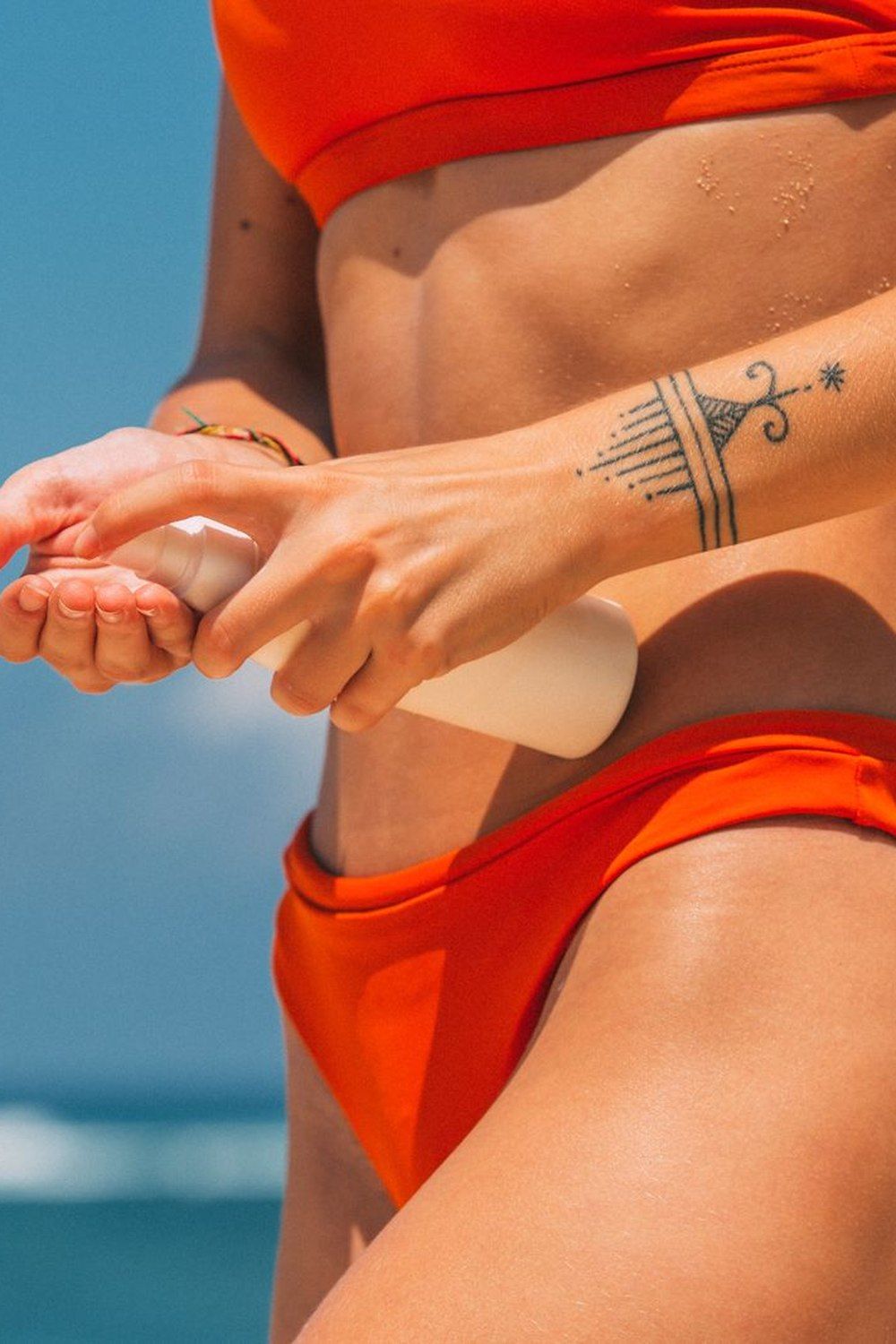
You already know sunscreen matters. The hard part is using enough of it, every day, without thinking about it. Most people apply only a quarter to half of the amount sunscreen is tested with, according to the Skin Cancer Foundation — so the SPF on the bottle is rarely the protection on their skin. This guide covers the rules that fix that: amounts, reapplication, honest SPF numbers, and sunscreen under makeup.
broad-spectrum SPF 30 or higher; one ounce (a shot glass full) for your body, a teaspoon — two finger-lengths — for face and neck; apply 15 minutes before going out; reapply every two hours outdoors and after swimming, sweating heavily, or toweling off.
Start with the label: three things to look for
The American Academy of Dermatology (AAD) recommends checking three things on the bottle: Broad spectrum — tested to protect against both UVA and UVB. UVB mainly causes sunburn; UVA penetrates deeper, drives skin aging, and also plays a role in skin cancer. SPF only measures UVB, so without "broad spectrum" you miss half the picture. SPF 30 or higher — the AAD's daily baseline; the Skin Cancer Foundation suggests water-resistant SPF 50+ for extended outdoor activity. Water resistant — worth having for sweat or swimming days, with a catch explained below. You will never see "waterproof" or "sweatproof" on a US label — the FDA bans those claims, because every formula eventually washes or sweats off.
How much is enough: exact amounts
SPF is tested in the lab at 2 milligrams per square centimeter of skin. These measures get you close at home: Whole body (skin not covered by clothing): about 1 ounce — a shot glass full, or 2 tablespoons, per the AAD, the FDA, and the Skin Cancer Foundation. Face and neck: at least 1 teaspoon — the AAD pegs this at about the amount covering the length of your index and middle fingers: the two-finger rule. A line along both fingers, base to tip, is your dose. It feels like a lot the first time — that feeling is the point. Lips: a lip balm with SPF 30 or higher, reapplied like any sunscreen. Reality check from Mayo Clinic: a 4-ounce bottle holds only about four full-body applications. If one bottle lasts a whole summer, you are under-applying.
The spots everyone misses
Per the AAD, the commonly missed — and commonly sun-damaged — areas are the ears, back of the neck and hairline, the scalp's part line (a wide-brimmed hat covers it best if hair is thinning), backs of the hands, tops of the feet, and lips.
When to apply, and when to reapply
Apply about 15 minutes before you go outside. Skin needs roughly that long to absorb sunscreen and be protected, per the AAD. It matters most for chemical filters — Cleveland Clinic puts their absorption time at about 20 minutes — while mineral filters work immediately. Apply at home, not on the beach. Reapply every two hours while you are outdoors. A higher SPF does not change this — SPF 50 lasts no longer than SPF 30. Reapply sooner here: Swimming: reapply immediately when you get out and towel off. "Water resistant (40 minutes)" or "(80 minutes)" means the product kept its SPF through that much time in water during FDA testing — not all afternoon; that clock starts the moment you get wet. Sports and heavy sweating: reapply right after heavy sweating; two hours is the outer limit, not the target. Beach and snow days: water, sand, and snow reflect and intensify UV, so hold to the two-hour rule and add shade and clothing. Office days: far from windows, a thorough morning application covers incidental exposure. Beside a bright window or out at lunch, reapply at midday — UVA passes through glass, though glass largely blocks UVB. Kids: children 6 months and older follow the same schedule. For babies under 6 months, AAD guidance is shade and clothing first; if those are unavailable, a minimal amount of broad-spectrum, water-resistant SPF 30 may be applied — mineral formulas (zinc oxide, titanium dioxide) are less likely to irritate a baby's skin. Cloudy days are not a free pass — up to 80% of UV rays penetrate cloud cover (AAD), which is why people burn on grey afternoons. Winter is no exception: our winter skincare routine keeps sunscreen as its fifth step for exactly this reason.
SPF explained honestly
SPF (sun protection factor) measures protection against UVB, the burning rays. It does not measure time: the FDA is explicit that SPF is about the amount of UV exposure, not hours in the sun — midday sun delivers far more per hour than early-morning sun. Applied properly, the numbers filter roughly this much UVB, per the AAD and the Skin Cancer Foundation: SPF 15 about 93%, SPF 30 about 97%, SPF 50 about 98%, and SPF 100 about 99%. Two honest conclusions: no sunscreen blocks 100% of UV rays, so pair it with shade and clothing and respect peak sun — rays are strongest between 10 a.m. and 2 p.m., and if your shadow is shorter than you are, seek shade (AAD). And the SPF 30-to-50 jump is small; the bigger win is the full amount, reapplied on time. A careful SPF 30 beats a thin smear of SPF 100.
Mineral or chemical? Pick the one you will wear
Both types are effective; dermatologists repeat one bottom line — the best sunscreen is the one you will actually use. Mineral (physical) sunscreens use zinc oxide, titanium dioxide, or both, sit on the skin's surface, and work immediately. One nuance from Cleveland Clinic: both types work primarily by absorbing UV and converting it to heat — mineral also reflects and scatters some UV, less than the "tiny mirrors" picture suggests. Mineral suits sensitive skin, children, and rosacea, but is thicker and may leave a white cast on deeper skin tones; tinted versions reduce it. Chemical sunscreens use filters such as avobenzone and octocrylene, absorb UV like a sponge, rub in easily, feel lighter, leave no cast, and wear better under sweat and water. They need roughly 15–20 minutes to become effective and can sting in the eyes. If a formula irritates your skin or disrupts your skin barrier, switch types rather than skipping sunscreen — a fragrance-free mineral formula is the usual next step for reactive skin.
| Feature | Mineral (physical) | Chemical |
|---|---|---|
| How it works | Sits on the surface of the skin. It absorbs UV and turns it into heat, and it reflects and scatters some UV as well. | Soaks into the skin and absorbs UV like a sponge, turning it into heat. |
| Filters to look for | Zinc oxide, titanium dioxide, or both. | Filters such as avobenzone and octocrylene. |
| When to apply | Works straight away, as soon as it is on your skin. | Needs about 15 to 20 minutes on the skin before it becomes effective, so put it on before you head out. |
| White cast | Can leave a white cast, most visible on deeper skin tones. Tinted versions reduce it. | No white cast. It rubs in clear. |
| Feel on skin | Thicker and heavier. | Lighter, and rubs in easily. |
| Best for | Sensitive skin, children and rosacea. | Sweaty or swim days, and anyone who wants a light feel with nothing visible on the skin. |
| Worth knowing | For reactive skin, a fragrance free mineral formula is the usual next step when a sunscreen irritates. | Can sting if it gets into the eyes. |
| Swimming and sweat | Water resistance is a label claim, not a type. Choose a water resistant formula and reapply after swimming or toweling off. | Wears better under sweat and water. Still reapply after swimming, and every two hours outdoors. |
Both types work. The best sunscreen is the one you will actually use, in the full amount, reapplied on time.
Wearing sunscreen under (and over) makeup
Sunscreen goes on last in skincare, after moisturizer, before makeup. Let it set a few minutes to form an even film, then pat and press foundation on gently — rubbing hard can shift the sunscreen underneath. Makeup with SPF is a bonus, not a base. The AAD's position is blunt: SPF in makeup or moisturizer can help but is rarely sufficient alone — almost nobody applies foundation thickly enough to reach the labelled SPF, and makeup is seldom reapplied as sunscreen should be. For long outdoor days, layer makeup over a real, full-dose sunscreen. Reapplying over makeup is where routines break down, and the options are compromises — top-ups, not replacements for your morning layer. A spray disturbs makeup least: spray until skin glistens, then rub it in; never spray directly onto your face (into your hands first) and avoid inhaling it. An SPF powder or stick suits small touch-ups, but neither goes on thickly enough to match its labelled protection.
Common mistakes that quietly cancel your sunscreen
Using too little (the biggest one); applying at the beach instead of before leaving; trusting "waterproof," which does not exist; relying on makeup SPF alone for a full outdoor day; spraying without rubbing in; using an expired or heat-damaged tube (see below); and skipping cloudy days, winter, and driving, when UVA still gets through clouds and glass.
Expiry dates and storage
Sunscreen expires, on a longer timeline than many think: FDA regulations require it to remain at its original strength for at least three years, and Mayo Clinic confirms leftovers can be used year to year within that window. Printed expiration date? Follow it; discard the product once it passes. No printed date? Write the date you bought it on the bottle; discard it three years later. Whatever the date, discard sunscreen that has changed color, separated, developed an unusual odor, or changed texture — visible changes can signal breakdown. Heat speeds up breakdown: never store sunscreen in a hot car or direct sun. At the beach, keep it shaded, wrapped in a towel, or in a cooler (Mayo Clinic). One habit worth copying from dermatologists: check your skin now and then, and get any new, changing, itching, or non-healing spot seen promptly. This is general information, not medical advice — for your own skin, see a board-certified dermatologist.
Frequently asked questions
How much sunscreen should I put on my face? About a teaspoon for face and neck — the two-finger rule: a line along the full length of your index and middle fingers. It looks like a lot next to a pea-sized dab; it is what the labelled SPF assumes. Do I need sunscreen on a cloudy day or indoors? On cloudy days, yes — up to 80% of UV rays penetrate cloud cover. Indoors, it depends where you sit: UVA passes through window glass, so a desk beside a sunny window or a long drive is real exposure. Deep indoors, exposure is much lower. Is the SPF in my foundation or moisturizer enough? Rarely. You would have to wear far more foundation than anyone does to reach the labelled protection, and makeup is almost never reapplied. Use a dedicated sunscreen underneath; makeup SPF is a bonus. Does sunscreen block vitamin D? Guidance from both the AAD and the Skin Cancer Foundation is not to use unprotected sun as your vitamin D plan. Studies summarized by the Foundation have generally not shown everyday sunscreen use causes deficiency in most people; food — plus a supplement if needed — is safer. Do people with darker skin need sunscreen? Yes. Melanin offers some sunburn protection, but people with skin of color can and do develop skin cancer — often diagnosed at later, more dangerous stages — and UV aggravates hyperpigmentation and melasma. Broad-spectrum sunscreen suits every skin tone; tinted mineral formulas avoid a white cast on deeper skin. Can I use last summer's sunscreen? Usually, yes — check the expiration date first; sunscreen must retain its strength for at least three years. Replace it if past its date, if you cannot remember when you bought an undated bottle, or if its color, smell, or texture has changed. If your skin is sensitive or mid-flare, calm it first with our gentle 7-day reset plan, then restart sunscreen on soothed skin.
Sources
Written by the Trendora Editorial Team. Facts checked against: American Academy of Dermatology — "How to apply sunscreen": https://www.aad.org/public/everyday-care/sun-protection/shade-clothing-sunscreen/how-to-apply-sunscreen American Academy of Dermatology — "Nine Sunscreen Questions Dermatologists Hear Every Summer — Answered": https://www.americanacademyofdermatology.org/nine-sunscreen-questions-dermatologists-answered/ U.S. Food and Drug Administration — "Sunscreen: How to Help Protect Your Skin from the Sun": https://www.fda.gov/sunscreen U.S. Food and Drug Administration — "Tips to Stay Safe in the Sun: From Sunscreen to Sunglasses": https://www.fda.gov/consumers/consumer-updates/tips-stay-safe-sun-sunscreen-sunglasses Mayo Clinic — "Does sunscreen expire?": https://www.mayoclinic.org/healthy-lifestyle/adult-health/expert-answers/sunscreen-expire/faq-20057957 Cleveland Clinic — "Mineral vs. Chemical Sunscreen: Which Is Better?": https://health.clevelandclinic.org/mineral-vs-chemical-sunscreen The Skin Cancer Foundation — "Sunscreen": https://www.skincancer.org/skin-cancer-prevention/sun-protection/sunscreen/ The Skin Cancer Foundation — "How Much Sunscreen Is Enough?": https://www.skincancer.org/blog/how-much-sunscreen-in-enough/
General information only, not professional or medical advice.