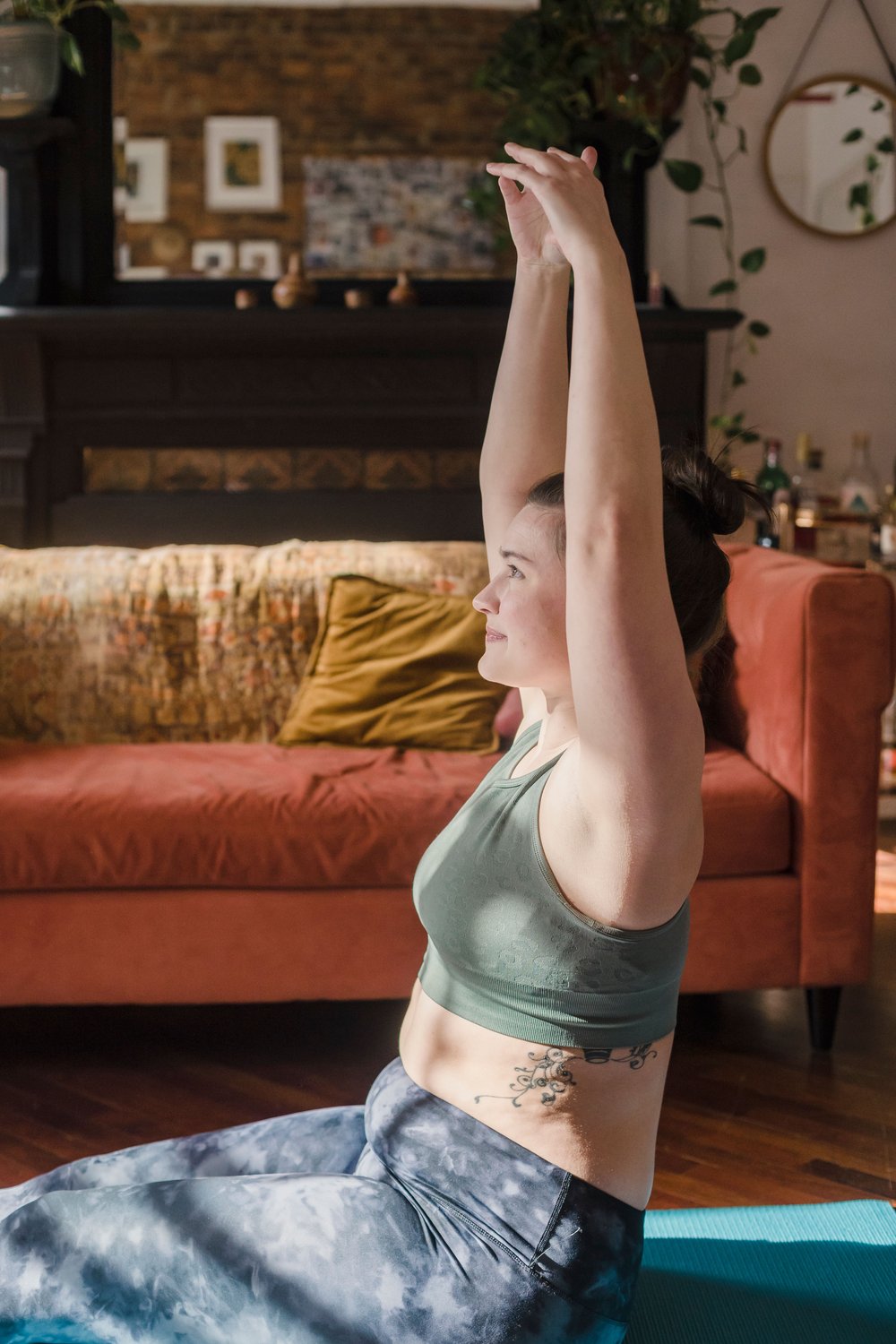
Most people wake up stiff and reach for their phone instead of their toes. After hours of lying still, muscles feel tight, the back complains, and the first hour of the day runs on autopilot. A short morning stretch routine will not transform your body, but it does something honest and useful: it loosens the stiffness, gets blood moving, and gives you ten quiet minutes before the day starts asking for things. This routine is built for beginners — no equipment, no floor acrobatics, nothing that needs flexibility you do not have yet. Every stretch is gentle, timed, and in an order that wakes the body up from the spine outward. This version of the article goes a little further than the basics: how to breathe through a stretch, how long to actually hold one, the mistakes that quietly cancel out a good routine, a desk-chair version for mornings you cannot get on the floor, and what realistic progress looks like over the first six weeks.
Stretch after a warm shower or a minute of walking around the room — warm muscles stretch more comfortably than cold ones, especially first thing.
Before you start: two safety rules
Rule one: a stretch should feel like a gentle pull, never pain. If something pinches, burns or shoots, ease off — pain is information, not progress. Rule two: never bounce. Move into each stretch slowly, hold it still, and breathe out as you settle in. Hold most stretches for about 30 seconds a side; shorter holds are fine while you are learning. Morning bodies are stiffer than evening ones, so expect less range than you would have at 6pm, and do not compete with yesterday. If you have a back injury, a recent surgery, or joint pain that keeps returning, check with a doctor or physiotherapist before starting any routine, including this gentle one.
Minutes 1 to 3: wake up the spine and shoulders
Start standing. Roll your shoulders slowly backwards five times, then forwards five times, and tilt one ear toward your shoulder for 30 seconds a side — the neck and shoulders carry the night's stiffness first. Then come onto all fours for cat-cow: on a breath in, let your belly drop and lift your head gently; on a breath out, round your back toward the ceiling. Move between the two slowly for about a minute, matching the movement to your breathing. Finish this block sitting back on your heels with arms stretched forward on the floor — a rest position — for 30 seconds, breathing slowly. Your spine has now moved in every direction it needs.
Minutes 4 to 7: hips, legs and calves
Stand up and step one foot forward into a short lunge, back heel down, and tuck your hips slightly under until you feel a stretch in the front of the back leg's hip. Hold 30 seconds, then switch sides — desk workers feel this one most, because sitting shortens exactly these muscles. Next, a standing forward fold: feet hip-width apart, knees soft, and let your upper body hang toward the floor for a minute, arms dangling or holding opposite elbows. Let gravity do the work; do not pull yourself down. Finish with calves: hands on a wall, one foot back, heel pressed down, 30 seconds a side. These three cover the areas that tighten overnight and during long sitting days.
Minutes 8 to 10: twist, breathe and stand tall
Lie on your back for the last block. Pull one knee across your body toward the opposite side, keeping the other shoulder on the floor, and hold for a minute; switch sides. This gentle spinal twist is where most people feel the morning's stiffness let go. Then hug both knees in for a few slow breaths. To finish, stand up, plant your feet, and take five slow breaths with your arms rising on the inhale and falling on the exhale. Notice what changed: your back feels longer, your shoulders lower. That is the whole routine — ten minutes, done before the kettle boils.
How to breathe while you stretch
Breathe normally through your nose the whole way through — there is no special breathing technique to learn here. The one thing worth paying attention to: exhale slowly as you ease deeper into each stretch, and never hold your breath. The Mayo Clinic puts it simply: "Breathe freely... Try not to hold your breath." It matters more than it sounds. Holding your breath tenses the muscles you are trying to release and briefly raises your blood pressure, which works directly against the point of stretching. A slow exhale does the opposite — it signals the muscle to let go a little further. If you notice you have been holding your breath mid-stretch, that is usually a sign you have gone slightly too far; back off until your breathing settles back to normal.
The dose that actually works: how long to hold
The numbers, honestly: the American College of Sports Medicine recommends holding each static stretch for 15 to 30 seconds, repeating it 2 to 4 times, for a total of about 60 seconds per muscle group, at least 2 to 3 days a week — daily is fine and often better. The Mayo Clinic gives similar advice: hold about 30 seconds, and closer to 60 seconds for a particularly tight or problem area. The practical takeaway for this routine: two 30-second holds per stretch is the sweet spot. A quick 10-second bounce or tug does almost nothing — the muscle has not had time to respond before you have already moved on. On the other end, piling on more than four repeats of the same stretch adds very little benefit for the extra time it costs. If a morning feels rushed, one good 30-second hold per stretch, done without rushing, beats several rushed ones.
Five mistakes that quietly undo a stretch routine
Small habits can cancel out ten minutes of otherwise good stretching. The most common ones: Bouncing instead of holding still. The Mayo Clinic is specific about this: bouncing into a stretch can actually injure the muscle and leave it tighter, not looser. Ease in slowly and stay still. Stretching cold muscles with no warm-up at all. Rolling straight out of bed onto the floor works against you. Mayo Clinic recommends 5 to 10 minutes of light movement first — walk around the room, or stretch after a warm shower — so the muscle is pliable rather than stiff and cold. Holding your breath. Covered above, but it is common enough to repeat: it tenses the exact muscle you are trying to relax. Forcing depth and chasing yesterday's range. Morning range of motion is naturally smaller than evening range. Trying to match how far you stretched last night, or yesterday morning, just invites pain instead of progress. Meet your body where it is today. Stretching only one side. It is easy to do the side that feels good and skip or shortchange the tight one. Always match left and right, even when one side clearly needs less.
The desk version: the same ten minutes in a chair
Not every morning allows for floor time — maybe you are traveling, working from a desk early, or just do not have the space. This version covers the same ground sitting or standing near a chair or desk, with the same 30-second holds and the same breathing. Seated neck tilts: sitting tall, tilt one ear toward your shoulder, 30 seconds a side. Seated shoulder rolls: five slow rolls back, five forward. Seated spinal twist: feet flat, twist gently toward the back of the chair, holding onto it lightly, 30 seconds a side. Seated hip stretch: cross one ankle over the opposite knee and lean forward gently from the hips, 30 seconds a side — this reaches the same hip muscles as the standing lunge. Standing calf stretch at the desk: hands on the desk, one foot back, heel pressed down, 30 seconds a side. Standing forward fold with hands on the desk: step back slightly, hinge at the hips, and let your upper body fold with hands resting on the desk edge for support, held for about a minute. This is a useful version of the routine, not a lesser one. Same muscles, same timing, same benefit — just adapted to the furniture you have.
What changes after two, four and six weeks
It helps to know what to actually expect, instead of guessing. In weeks one and two, the routine itself gets easier — the movements feel more familiar, and morning stiffness tends to ease sooner in the day. By weeks three and four, most people notice a little more range in their tightest spots, usually the hips and hamstrings; the forward fold or the lunge will feel slightly less locked than it did on day one. By week six, the routine has usually become a habit rather than a decision, and the real payoff shows up less in how far you can reach and more in how the day starts — looser, calmer, less braced against the first hour. Flexibility improves slowly, and only with regularity. There is no seven-day transformation here, and anyone promising one is selling something. What this routine offers is smaller and more honest: a little more ease, a little sooner, as long as you keep showing up for it.
How to make it a daily habit
Attach the routine to something you already do: after the shower, while coffee brews, or before you get dressed. Habits tied to an existing moment survive; habits that need a new decision every morning do not. Keep a mat or a clear patch of floor ready the night before if that helps. Three or four mornings a week is a good start — daily is lovely, but consistency at four beats a perfect week followed by none. On busy mornings, do half: the spine block and the forward fold alone take four minutes and still count. Stretching pairs well with real exercise rather than replacing it — our beginner home workout is the natural next step on the days you want more. Round the day off kindly too: our body care basics cover the evening scrub-and-moisturize version of the same idea.
Quick questions
How long should I hold each stretch? About 30 seconds per side is the standard guidance for most stretches. Repeat a favourite twice if it feels good, and always let pain — not the clock — decide when to stop. Is morning or evening stretching better? Both work. Mornings target the stiffness from sleep and set up the day; evenings can go a little deeper because muscles are warm. Pick the time you will actually keep. Can stretching replace exercise? No. Stretching maintains flexibility and comfort, but your body still needs movement that raises your heart rate and builds strength. Think of this routine as the warm-up act, not the whole show. Should I stretch before or after a workout? Before exercise, keep it moving: gentle dynamic movement works as a warm-up. Save the long, still, static holds for after exercise or a separate session, when muscles are already warm. As the Mayo Clinic puts it, "Even better, stretch after your workout when your muscles are warm." Why am I stiffer in the morning than the evening? After hours lying still, muscles cool down and joints have less natural lubrication overnight. Gentle movement and warmth ease this quickly — it is a normal overnight effect, not a sign anything is wrong. Is it normal to feel sore after stretching? Mild tenderness the next day can happen when you are just starting out, especially in a tight area. Sharp pain, numbness or tingling is not normal — stop and get it checked.
Sources and further reading
Written by the Trendora Editorial Team. Sources and further reading: the Mayo Clinic (mayoclinic.org) — stretching basics, including warming up for 5 to 10 minutes before stretching cold muscles, never bouncing, holding stretches for about 30 seconds (about 60 seconds for problem areas), breathing normally without holding your breath, and stretching after a workout when muscles are warm; the American College of Sports Medicine — flexibility guidance recommending static stretches held for 15 to 30 seconds, repeated 2 to 4 times, for about 60 seconds total per muscle group, at least 2 to 3 days a week; Harvard Health (health.harvard.edu) — the benefits of regular stretching for flexibility and everyday movement. This routine is general wellness guidance, not medical advice.
General information only, not professional or medical advice.